

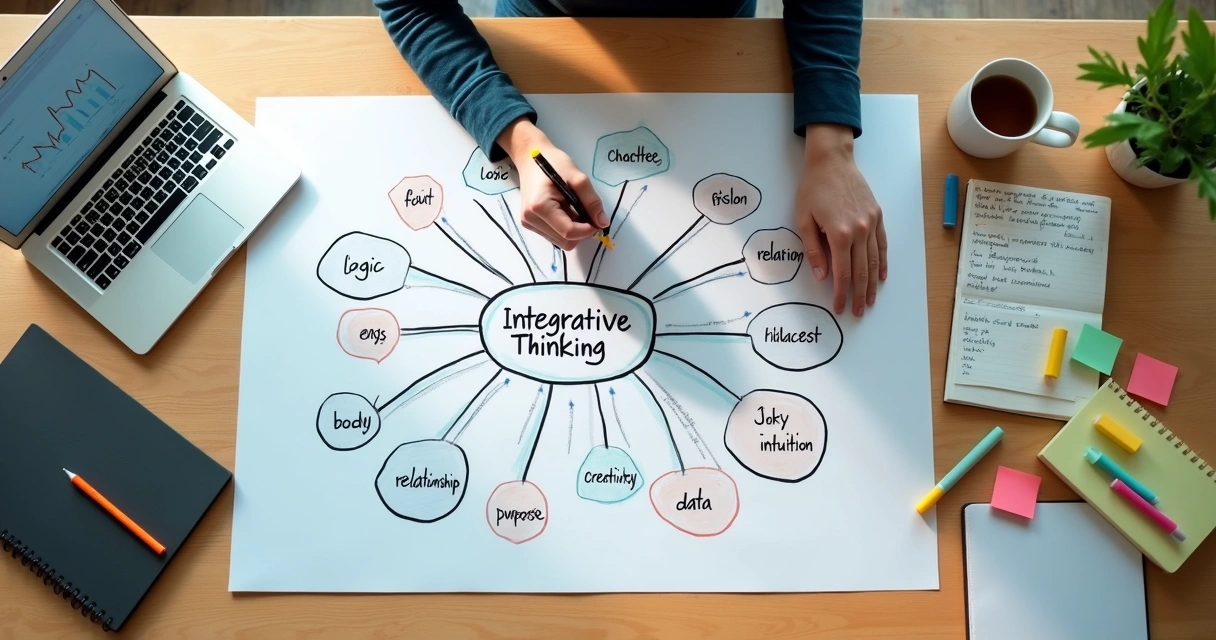
Integrative thinking is one of the rare skills that helps us bridge gaps—within ourselves, with others, and across ideas. In our experience, it's the difference between getting stuck on problems and turning them into meaningful solutions. We often notice how leaders and innovators rely on this flexible mental tool, not only to sort out conflict but also to create something new, responsible, and sound. If you are interested in making better decisions and drawing more value from challenges, strengthening your integrative thinking is a wise move. Here are seven practical ways we find work best.
Practice viewing problems from multiple perspectives
The habit of looking at issues through just one lens is common. We all fall into that trap sometimes. To grow as integrative thinkers, we need to practice seeing situations from several points of view. When facing a challenge, pause and ask:
- How might someone with a totally different background see this?
- What assumptions are we making that could be questioned?
- Where do our interests overlap with others?
By deliberately switching perspectives, we unlock a broader range of options and risks that one viewpoint might miss. This step can feel awkward at first, but the more we do it, the more natural and valuable it feels.
Connect ideas that seem unrelated
Integrative thinking blooms when we connect dots others miss. Think about times when two unrelated concepts led to a breakthrough solution: combining art techniques to teach mathematics, or blending two different business models to reach new customers. Building this connection skill relies on playful curiosity.
Look for patterns in the chaos.
A few practical tips:
- Read articles outside your regular field.
- Try combining two random ideas and sketch out possible links.
- Ask, “What if we mix...?” during brainstorming sessions.
Doing this trains our mind to find harmony in apparent opposites and build bridges where walls once stood.

Embrace healthy conflict
We rarely move forward by only agreeing with each other. In fact, productive tension between opposing ideas often drives progress. Healthy conflict happens when we welcome disagreement as a chance to discover something better, not win the argument.
When a disagreement comes up, try using these approaches:
- Listen fully before responding—sometimes the core issue is not what it seems.
- Frame the conversation as “us against the problem” instead of “us versus them.”
- Focus on the value in opposing insights.
Over time, practicing this form of respectful friction refines our ability to integrate all angles, making solutions deeper and more sustainable.
Map the deeper system behind the issue
Most challenges aren’t isolated—they’re influenced by unseen relationships, habits, and past decisions. Integrative thinkers ask, “What’s really driving this?” We find it useful to actually draw a map of the elements involved:
- Who or what is involved?
- How do different parts affect each other?
- Where do small changes create big impacts?
This systems approach stops us from treating symptoms and pushes us to address real causes. Even a simplified drawing on a notepad can bring powerful clarity.

Practice reflective questioning
Sometimes, we act on auto-pilot. To break this habit and encourage integrative thinking, we need to slow down and ask ourselves reflective questions:
- What else could be true here?
- What are we avoiding?
- How could our own beliefs be limiting options?
Reflective questions help us challenge both the story we tell ourselves, and the hidden assumptions behind our decisions. We often recommend keeping a notebook or using a voice recorder to track these thoughts over time.
Seek feedback and model thinking aloud
We learn when others show us how they solve problems, not just when they give us answers. Modeling our thought process aloud—especially how we balance trade-offs and connect different ideas—can encourage others to share theirs too.
- Invite teammates or friends to “think out loud” with you.
- Ask for feedback specifically about your reasoning, not just your conclusions.
- Be open about what feels confusing or uncertain.
We strengthen our own thinking by noticing how others approach complexity, combining their methods into our own.
Commit to lifelong learning and conscious development
No matter where we start, integrative thinking grows through regular, often small, intentional steps. We recommend exploring topics that stretch your usual mindset:
- Listen to podcasts, watch lectures, or attend discussions on different philosophies and frameworks.
- Take up journaling or meditation to increase your awareness of your own patterns.
- Regularly reflect on moments you changed your mind or learned from someone radically different.
Growth comes from choosing to stay curious.
By seeing yourself as someone who can always learn, you encourage your mind to make new connections naturally.
Conclusion: Integration leads to clarity and new possibilities
In our experience, integrative thinking is not about finding perfect answers, but about framing better questions and creating paths that connect the dots others overlook. When we train ourselves to welcome contradiction, examine different angles, and seek links rather than splits, we cultivate a clarity that informs wiser decisions—in life, relationships, and work.
Small, deliberate adjustments in our thinking make integrating complex ideas into daily practice possible. Whether through new perspectives, healthy disagreement, or mapping hidden systems, each step brings us closer to real transformation. With practice, integrative thinking becomes a part of who we are and how we show up in the world.
Frequently asked questions
What is integrative thinking?
Integrative thinking is the skill of holding different or opposing ideas at the same time and creating a new solution that draws from the best parts of each. Rather than choosing one approach and rejecting another, we blend multiple perspectives to find new possibilities. This ability helps us solve problems that are complex, uncertain, or have conflicting viewpoints.
How can I improve integrative thinking?
Improvement usually starts by staying open to different viewpoints and looking for patterns between ideas. Practical steps include practicing empathy, reflecting on your decisions, inviting feedback, and mapping connections between seemingly unrelated concepts. These habits develop with regular practice and curiosity.
Why is integrative thinking important?
Integrative thinking helps us respond to complex challenges, work more effectively in teams, and create new value where others see only trade-offs. It leads to original solutions and better outcomes in personal life, organizations, and society because it welcomes complexity and seeks to build rather than divide.
What are examples of integrative thinking?
Examples include combining two business models to launch a new kind of service, merging insights from different cultures to improve team collaboration, or reconciling goals in a negotiation by creating a solution that addresses everyone’s needs. Whenever we create a new option from ideas that seem incompatible, we are using integrative thinking.
Is it worth it to learn integrative thinking?
Yes, learning integrative thinking helps us manage challenges more skillfully and adapt to changing situations. People who use integrative thinking often find they make better decisions and feel more satisfied with their solutions, as they bring more depth and connection to their lives and work.