

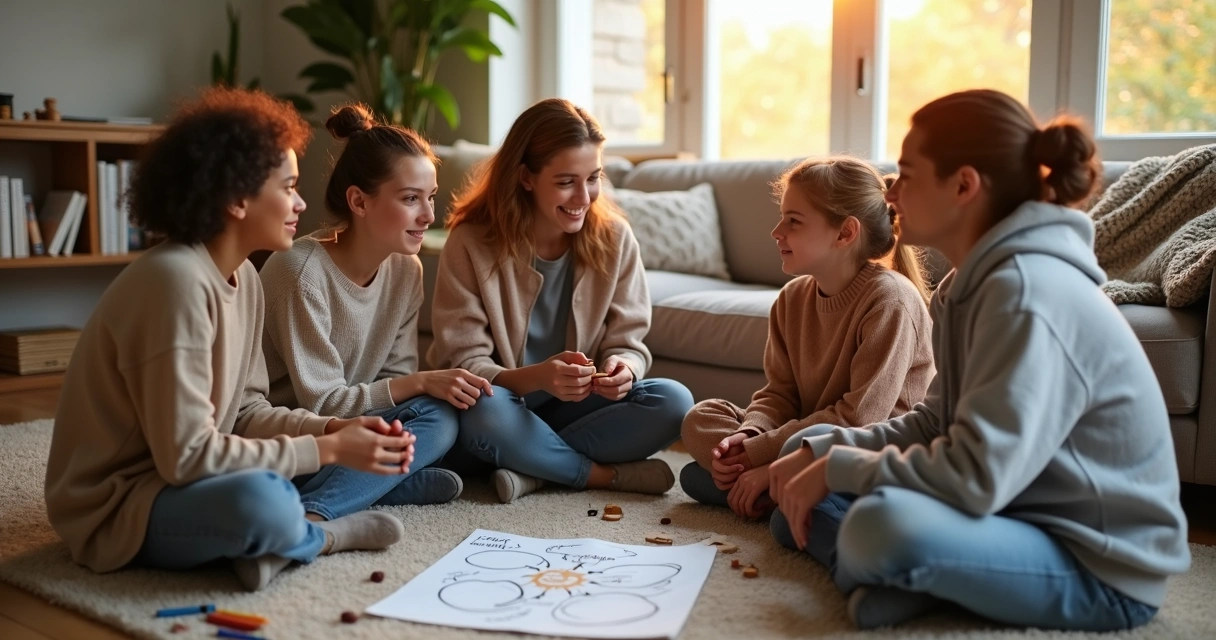
Many parents tell us the same thing. Their teenager is smart, fast, and deeply aware of social issues, yet at home they can seem cold, sharp, or closed off. This can feel confusing. We may ask ourselves how a young person who speaks about fairness can still dismiss a sibling’s pain or react with little care in tense moments.
Empathy in adolescence does not grow from lectures alone. It grows inside relationships, repeated experiences, and the emotional climate of the home. A systemic view helps us see that a teen’s behavior is rarely isolated. It is shaped by family patterns, stress, trust, boundaries, and the way feelings are handled day after day.
When we foster empathy systemically, we work on the whole relationship field, not only on the teen’s behavior.
In our experience, this shift changes the tone of parenting. We stop asking only, “How do we fix this reaction?” and start asking, “What in the family system is feeding disconnection, fear, or defensiveness?” That is where real progress often begins.
Why a systemic view helps
Teenagers are in a stage of identity building. They want freedom, but they still need emotional safety. They push back, but they also watch us closely. They test limits, but they still learn from the tone of our presence.
A systemic approach looks at patterns such as:
- How conflict is handled at home
- Whether emotions are welcomed or judged
- How power and voice are shared in the family
- Whether repair happens after hurt
- How stress spreads between family members
Research supports this broader view. A Journal of Adolescence study on parental support and empathy found that maternal support was linked to adolescents’ affective empathy, while agreeableness related to both parental support and empathy. We read this as a practical signal. Supportive bonds do not just make home feel nicer. They help shape how teens feel and understand the feelings of others.
Empathy is learned in contact.
Start with emotional modeling
Parents often focus on what teenagers should do. We think it is just as useful to look at what they see us do. If we mock, rush, interrupt, or dismiss, they absorb that rhythm. If we pause, listen, name emotions, and repair after conflict, they absorb that too.
This does not mean being perfect. In fact, teenagers tend to trust honesty more than performance. A parent who says, “I was too harsh earlier. I think you felt cornered. I want to try that again,” teaches empathy in action.
Repair is one of the strongest lessons a parent can offer a teenager.
We have seen simple modeling practices work well over time:
- Name your own feelings without drama
- Ask before giving advice
- Reflect what you heard before correcting
- Apologize clearly when you miss the mark
- Show concern for people outside the family in daily life
These are quiet tools. Yet they reshape the emotional culture of the home.

Use structured listening at home
Many empathy problems are not caused by lack of morals. They are caused by speed. Teenagers react fast. Parents react faster. Then nobody feels heard.
Structured listening slows the process. It gives each person a place in the exchange. We often suggest a simple three-step method for tense moments:
- One person speaks for two minutes without interruption.
- The listener reflects back the message and feeling.
- The speaker confirms or adjusts what was understood.
This can feel awkward at first. Then something shifts. The teen notices that understanding comes before judgment. That alone lowers defensiveness.
One mother once told us that her son rolled his eyes the first three times they tried this. On the fourth, he said, “That’s not what I meant, but that’s closer.” It was a small sentence. Still, it opened a door.
Map the family patterns
Systemic tools become stronger when we name recurring patterns. We can ask:
- Who is usually ignored when conflict starts?
- Who becomes the problem holder in the family?
- What topics trigger shame, silence, or blame?
- When one person is upset, how do others react?
This kind of mapping helps parents stop personalizing every teen reaction. Sometimes a teenager lacks empathy in the moment because they are overloaded, guarding themselves, or repeating a family pattern they have watched for years.
A repeated pattern is easier to change once the family can see it clearly.
You can map patterns with a weekly check-in. Keep it short. Ask each family member what helped connection that week and what blocked it. Over time, hidden rules become visible.
Match guidance to the teen
Not every teenager responds to the same kind of parenting. Some open up when we ask direct questions. Others feel watched and shut down. This is why a one-size-fits-all method often fails.
A longitudinal study on parental monitoring and empathy differences showed that the effects of parental solicitation on antisocial behavior varied depending on the adolescent’s level of empathy. We take this as a clear warning against rigid formulas. The same strategy can help one teen and push another into resistance.
So we can adjust our approach. A teen with low emotional awareness may need help naming inner states. A teen with strong feelings but poor boundaries may need support tolerating discomfort without lashing out. A teen who already feels a lot may need help turning empathy into action instead of guilt.
Create experiences of perspective-taking
Empathy grows when teenagers practice seeing beyond their own view. We can build this into normal life without turning every conversation into a lesson.
Useful practices include:
- After a conflict, ask what each person may have felt
- During films or stories, pause and ask what drives a character’s choices
- Invite teens to help care for younger siblings, older relatives, or community tasks
- Ask them how they would want to be treated in the same situation
The key is tone. If the question feels like a trap, empathy shrinks. If it feels curious and steady, reflection grows.

Strengthen support before correction
Empathy rarely grows in a climate of constant criticism. Boundaries matter, yes. But correction works better when the relationship has warmth. A recent Child Development study on empathic parenting across generations found that mothers’ empathic support at age 13 predicted teens’ empathy for close friends across adolescence, with effects that reached later parenting and even the next generation. That is a strong reminder that support leaves a long trace.
We do not need to choose between kindness and limits. We can hold both. We can say, “I see that you were upset, and speaking to your sister that way is not okay.” This joins understanding with accountability.
Conclusion
When parents want to foster empathy in teenagers, the first move is not pressure. It is awareness. We look at the family climate, the emotional habits, the hidden roles, and the quality of repair after friction. Then we use simple tools that teach empathy through lived experience.
There is hope in this. A teen who seems distant today is not fixed in that position. With support, structure, and a home where feelings can be named without fear, empathy can deepen. Slowly sometimes. Unevenly at times. Still, it grows.
What we repeat becomes the lesson.
Frequently asked questions
What is empathy in teenagers?
Empathy in teenagers is the ability to notice, understand, and respond to another person’s feelings. It includes both emotional empathy, which is feeling with someone, and cognitive empathy, which is understanding their point of view.
How can parents teach empathy at home?
Parents can teach empathy at home by modeling respectful listening, naming emotions, repairing after conflict, and asking reflective questions during daily situations. Teens learn a great deal from the emotional tone they live with each day.
What are systemic tools for empathy?
Systemic tools for empathy are practices that work with the whole family pattern, not just one behavior. They include structured listening, family check-ins, pattern mapping, clear repair after hurt, and guidance that fits the teen’s emotional style.
Why is empathy important for teens?
Empathy helps teens build healthier friendships, handle conflict with less aggression, and make better social choices. It also supports emotional maturity because teens learn to balance their own needs with awareness of others.
How can I spot lack of empathy?
We may spot lack of empathy when a teen repeatedly dismisses others’ feelings, shows little curiosity about the impact of their actions, mocks vulnerability, or stays focused only on their own frustration during conflict. One moment does not define them, but repeated patterns deserve attention.