

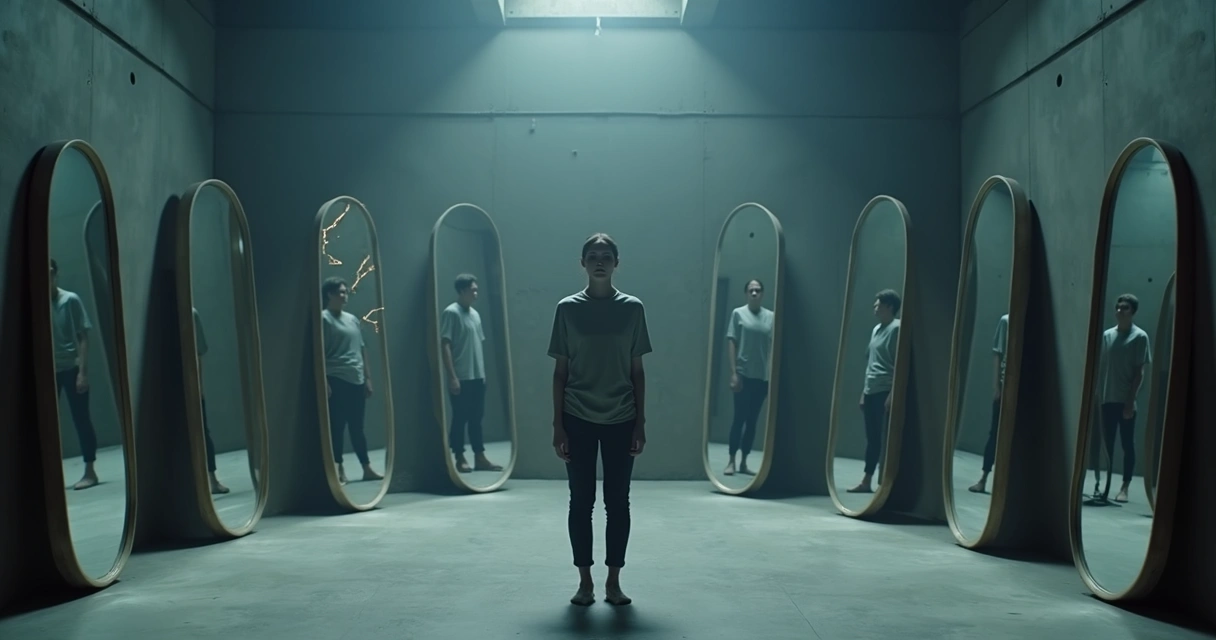
We often think that old stories about ourselves fade when life changes. Yet many of us notice the opposite. We get a new job, enter a new relationship, or make a clear decision to live differently, and still the same inner sentence returns: “I am not enough.” “People leave.” “Nothing works for me.” It can feel irrational. But it is not random.
Emotional feedback loops keep old narratives alive by linking feeling, thought, memory, and behavior in a self-reinforcing cycle.
In our experience, this cycle does not begin with logic. It begins with emotional charge. A person may hear a neutral comment, feel tension in the chest, remember an old wound without noticing it, and then interpret the moment through a familiar story. The story feels true because the body is already reacting as if the past were happening again.
That is why change can seem slow. We are not only changing thoughts. We are changing a pattern that has been repeated across time, often below conscious awareness.
How the loop forms
An emotional feedback loop usually starts with a trigger. It may be small. A delayed reply. A face that looks distant. A mistake at work. Then the nervous system reacts before reflection has time to arrive. The body tightens. Emotion rises. Thought moves fast. Meaning is assigned.
Once meaning appears, behavior follows. We may withdraw, defend ourselves, seek approval, overexplain, or attack. Then the response we receive from others seems to confirm the story we already carried.
The cycle often looks like this:
A trigger appears in the present.
An old emotional state is activated.
The mind creates a familiar interpretation.
Behavior follows that interpretation.
The outcome is read as proof that the story was true.
We have seen this happen in quiet ways. A person expects rejection, becomes guarded, sounds cold, and then receives distance from the other side. The result hurts. But the hurt does not only come from the present event. It also comes from the older narrative being fed again.
What we feel can train what we believe.
The mind often treats repeated emotional intensity as evidence.
Why feelings seem to prove the story
Many people confuse familiarity with truth. If a story has been repeated for years, it starts to feel stable, even if it is harmful. The body knows its rhythm. The emotions know their path. The mind can reach its conclusion in seconds.
This is one reason old narratives survive even after we gain insight. We may understand a pattern during calm moments, but when emotion rises, the older pathway takes over. Insight without practice rarely rewrites the reaction.
We think this is where many people become hard on themselves. They say, “I know better, so why am I still doing this?” The answer is simple. Knowing is one layer. Emotional conditioning is another.
There is also a social side to this. Narratives do not live only inside one person. They spread through families, groups, and even whole societies. Emotion gives them force. Stories charged with fear, shame, anger, or hope travel further and stay longer. In fact, research on how narratives shape economic cycles suggests that narratives can explain roughly 20% of U.S. business cycle fluctuations. That tells us something wider than economics. When a story carries emotional weight and repetition, it can shape collective behavior for a long time.

How old narratives hide in daily life
Old narratives do not always announce themselves with dramatic language. They often appear as habits that seem practical or even reasonable. That is why they can stay hidden for years.
We may notice them in patterns such as:
Reading neutral events as personal rejection
Expecting failure before trying
Feeling guilty when resting
Choosing familiar pain over honest change
Repeating the same conflict with different people
At first glance, these seem like separate issues. Yet they often grow from one central story. “I must earn love.” “I am unsafe.” “My needs are too much.” “Control is the only way to avoid pain.” The forms change, but the narrative core stays intact.
When a narrative becomes emotional habit, it no longer needs proof to stay active.
We have seen people defend painful stories because those stories offer predictability. If we already expect disappointment, hope can feel risky. If we already expect criticism, openness can feel unsafe. So the loop keeps running, not because it helps, but because it feels known.
What interrupts the cycle
Breaking a feedback loop does not begin by arguing with ourselves. It begins by noticing the sequence in real time. We need enough inner space to say, “Something old is active in me right now.” That moment matters. It creates a gap between reaction and choice.
In our view, change usually asks for work in three areas at once:
Body awareness helps us catch the loop before thought hardens into story.
Emotional naming reduces confusion and lowers inner pressure.
New behavior gives the mind fresh evidence that the old narrative is not the only option.
For example, if someone feels ignored when a message goes unanswered, the old loop may push them toward panic or accusation. A new response could be slower. Feel the body. Name the fear. Pause the impulse. Ask a grounded question later, rather than reacting from injury. Small shifts like this are not weak. They are how a loop loses force.

Why repetition can still lead to freedom
There is a hard truth here. Old narratives rarely disappear after one insight, one conversation, or one decision. They weaken through repeated new experiences. This can feel slow. It can also feel discouraging. But repetition created the loop, and repetition can reshape it.
We do not need perfection for this work. We need honesty and continuity. When we notice a trigger faster than before, that is progress. When we recover from a reaction in one hour instead of three days, that is progress. When we stop calling an old wound our identity, that is progress.
Little by little, the body learns that the present is not always the past. The mind learns that emotion is real, but not always accurate as interpretation. Behavior becomes less driven by defense and more guided by presence.
Awareness breaks automatic loyalty to the past.
Conclusion
Emotional feedback loops perpetuate old narratives because they make the past feel current, the familiar feel true, and the repeated feel permanent. Yet these loops are not destiny. They are learned patterns. What is learned can be revised.
When we observe the trigger, respect the emotion, question the first interpretation, and choose a different response, we begin to loosen the grip of the old story. This work takes patience. It also brings relief. With time, the narrative that once ruled our reactions becomes easier to see, easier to interrupt, and easier to leave behind.
Frequently asked questions
What is an emotional feedback loop?
An emotional feedback loop is a repeating cycle in which a trigger creates an emotion, the emotion shapes a thought, the thought drives a behavior, and the outcome seems to confirm the original feeling. This makes the pattern more likely to happen again.
How do feedback loops affect narratives?
Feedback loops affect narratives by giving them repeated emotional reinforcement. When the same feeling and interpretation happen again and again, the story feels more believable, even when it is incomplete or distorted.
Why do old beliefs repeat themselves?
Old beliefs repeat themselves because they are linked to emotional memory, body reactions, and learned behavior. They often return under stress, especially when present events resemble past wounds.
Can emotional loops be broken easily?
Emotional loops are usually not broken easily, because they are built through repetition over time. Still, they can be changed with awareness, emotional regulation, and consistent new responses to familiar triggers.
How to change negative emotional patterns?
We can change negative emotional patterns by noticing triggers early, naming what we feel, pausing automatic reactions, and practicing different behaviors. Supportive reflection, journaling, and steady inner work also help create new emotional pathways.